 ARMF
ARMFAllocation: spreading risk across strategies
Spreading risk across strategies is a task an ordinary trade copier does not solve: it duplicates someone else's entries unchanged and leaves the whole account hostage to a single system. Allocation approaches it from the other side — a farm of several robots and signals where each has its own share of equity and its own loss limit, while weak segments of the statistics can simply be switched off from copying. We take apart the mechanics of the platform and what it does not do.
Allocation is a platform for managing a portfolio of strategies: it gets access to a trading account in MetaTrader through a data exchange interface and lays the capital out in shares between subscriptions. The deposit is not transferred anywhere and stays where it was: the platform does not take it and is not a broker. The product site is allo.trading.
Why a single strategy is a concentration of risk
A subscription to one signal or one expert advisor looks like diversification compared with manual trading, but by the mathematics of risk it is still a single bet. The drawdown of the system becomes the drawdown of the account one to one, and a long losing period comes to any strategy — the only question is when.
| Situation | One strategy for the whole account | A portfolio of five shares |
|---|---|---|
| A streak of six stops in a row | the drawdown of the entire account | the drawdown of one share out of five |
| The strategy broke on a regime change | a minus until you decide to switch it off | the minus is limited by its share |
| One pair suddenly turned unprofitable | visible only in the account total | visible in the breakdown by instrument |
| A new system has to be tested | either instead of the current one or on a second account | a small share is allocated to it |
| Different entry logics | impossible to combine | they work in parallel |
| The decision to switch a system off | taken on emotion inside a drawdown | by the rule of the limit per subscription |
The figures are given according to the platform on the date of the check and may change: the catalogue is growing, and the access terms are published by the developer.
A portfolio does not remove losses and does not make strategies better. It changes something else — the price of a wrong choice: an unsuccessful subscription costs its own share, not the whole deposit.
A portfolio of forex advisors: how shares replace a bet on one
The main mechanism of the platform is smart equity allocation. Each strategy is given an amount it cannot go beyond, while the undistributed remainder stays as a reserve. A portfolio of forex advisors stops being a pile of connected signals and becomes a structure where every element has a weight.
| Strategy | Allocated | Share of equity | What it means |
|---|---|---|---|
| Gold MeanRev | $2,400 | 24 % | the size is counted from this amount, not from the account |
| EURUSD Trend | $1,000 | 10 % | the drawdown is limited by its own share |
| BTC Momentum | $800 | 8 % | an experimental share for testing |
| A new subscription | $1,800 | 18 % | is added without rebuilding the portfolio |
| Free reserve | $4,000 | 40 % | a buffer for margin and new ideas |
| Total in use | $6,000 | 60 % | the portfolio load is visible as a single number |
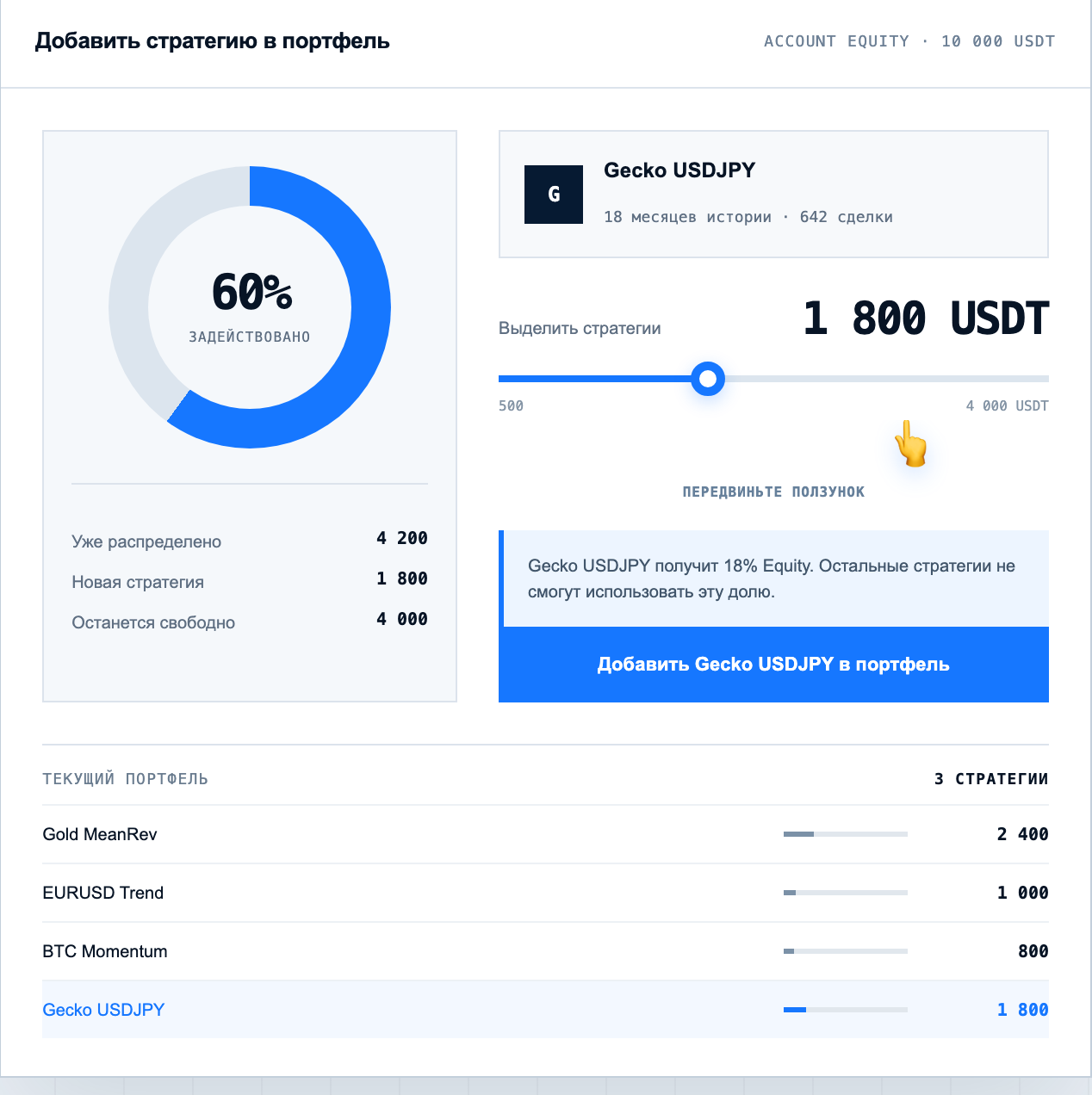
A screenshot of the platform demo mode: the figures in it are for illustration.
The load figure is the most practical one in this table. It answers the question that ordinary copying leaves open: what percentage of the account is right now managed by someone else's algorithms and how much sits in reserve.
Four mechanisms that manage the risk
The platform is built around decisions that are usually made by hand and therefore not made at all. Each of the four mechanisms closes a specific scenario of losing money.
The strategy trades a size taken from the allocated amount, not from the whole account. A mistake in lot size when connecting a new subscription stops being possible.
limit per subscriptionCopying starts not on the day of subscription but when the strategy reaches a set drawdown depth. The threshold is set from its own history: the average and the maximum drawdown of past cycles.
the entry pointA breakdown of the result by symbol, trading hours and days of the week. A losing segment is switched off from copying and the figures are recalculated before and after — you can see exactly what changed.
statistics put to workSubscriptions with history: some of them with a track record longer than a year. The choice is made on statistics, not on promises in an advertising post.
the source of subscriptions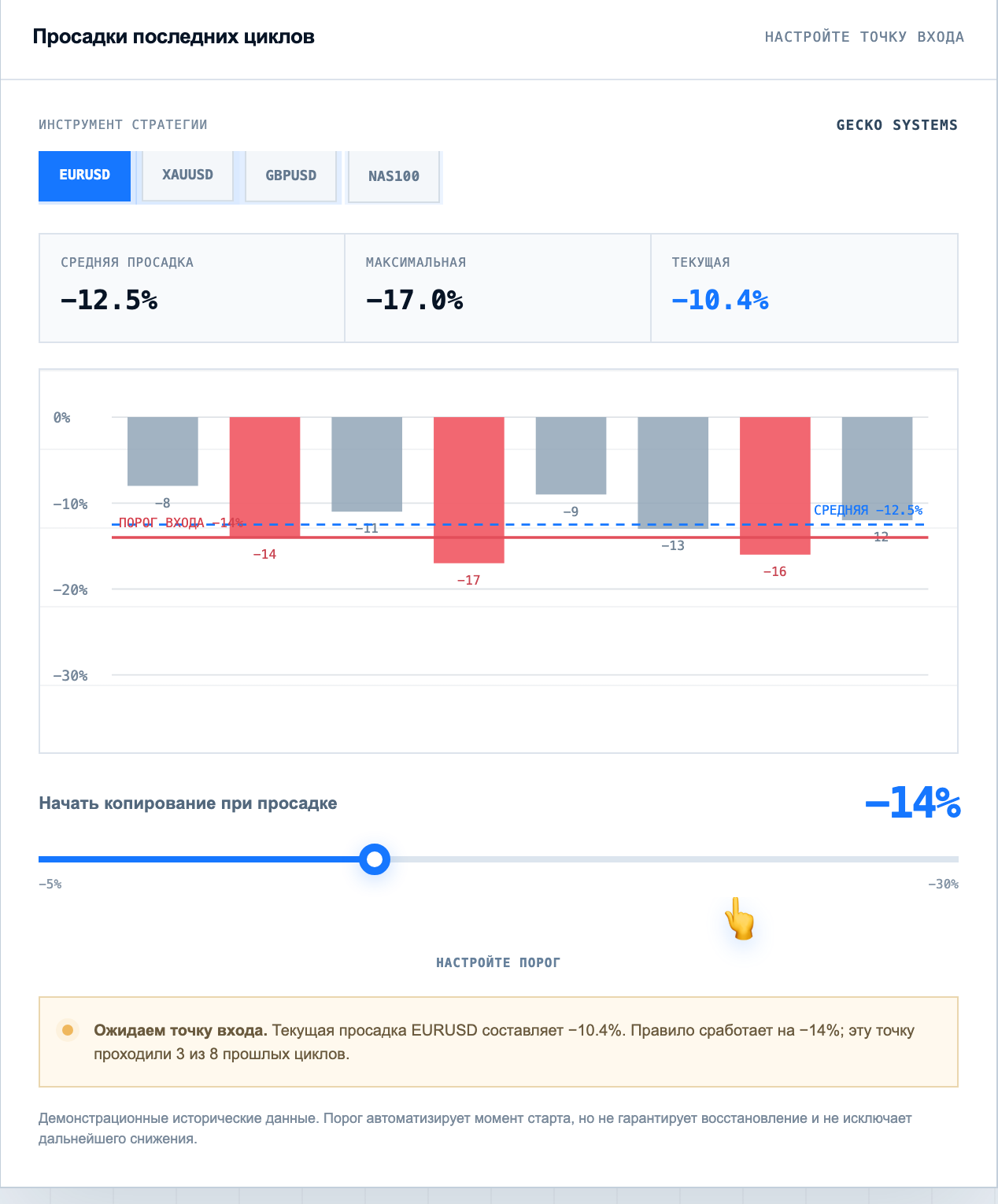
A screenshot of the platform demo mode: the figures in it are for illustration.
The second and third points are what ordinary copying services do not have. They are exactly what turns a subscription from a bet on someone else's luck into a decision based on data: when to enter and which trades to keep away from the account.
What the strategy breakdown shows
A subscription is rarely evenly profitable: usually part of the instruments and part of the trading hours drag the result down, while the overall equity curve hides it. The breakdown splits the trades into slices, and the weak segment is visible as a number rather than a feeling.
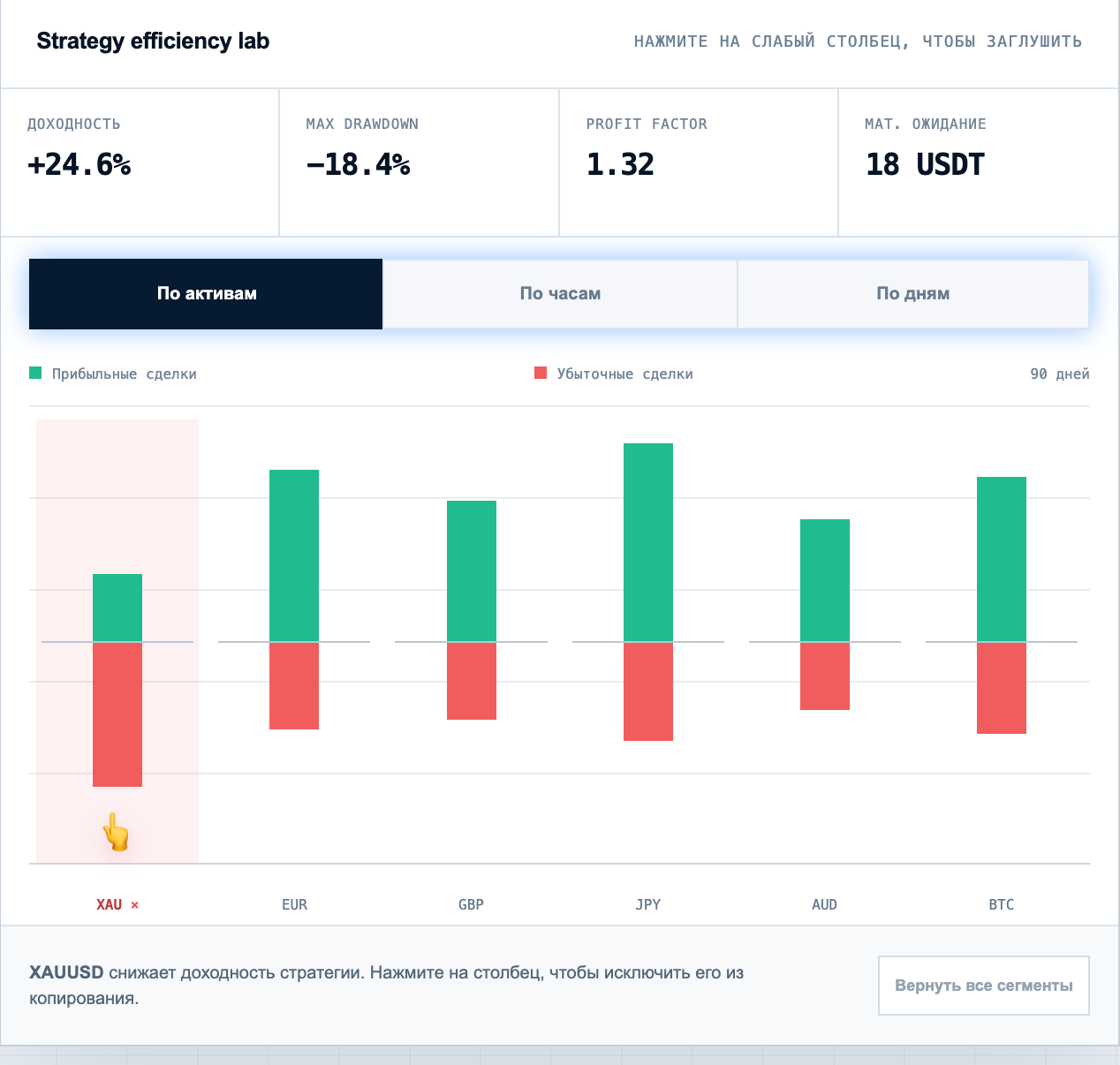
A screenshot of the platform demo mode: the figures in it are for illustration.
After that the decision is the trader's: the segment can be switched off from copying, and the figures will be recalculated on the remaining trades. It is worth remembering the limit of the method — the finer the slice, the fewer trades it holds and the higher the chance of taking randomness for a pattern. What should be switched off is what loses over hundreds of trades, not over a dozen.
The way from an account to a managed portfolio
The connection procedure takes an evening and does not require moving money anywhere: the trading account stays yours, and the platform gets access through an API.
The MetaTrader account is connected to the web interface. Only you can still dispose of the money.
onceSelection by length of history, drawdown depth and character of the trading, not by the top rows of last month's return.
by statisticsEvery subscription gets its own amount and its own limit. The free reserve is left deliberately: it holds the margin and leaves room for new ideas.
the key stepInstruments, hours, days, size limits. Weak segments of the statistics are switched off before they reach the account.
fine tuningA breakdown by slices and a revision of the shares: the share grows for what works and is cut for what stopped working.
continuouslyWhat stays outside the platform
The platform manages the allocation and the rules, but it does not cancel the nature of the market. Four limitations are worth understanding before buying a licence.
Where the tool fits and where it does not
The tool solves the task of allocation, not the task of finding profit. Hence the limits of where it fits.
What to find out before buying a licence
The platform is sold under a licence and the decision is made once, so four questions are better closed in advance. All four are covered by the developer during the product demo — a convenient way to test the scenario on your own numbers rather than on demonstration ones.
The developer runs a demonstration and a masterclass: the whole route from linking the account to a finished set of portfolio rules is shown live, and questions are asked right there.
half an hourThe base circuit is built around MetaTrader 4 and 5. It is worth naming your specific broker and account type in advance: symbol specifications and execution terms differ between venues.
before the licenceWhat matters is not the number of available strategies but how many of them have more than a year of history and how different their entry logics are. Five similar robots will not make a portfolio.
quality, not quantityAllocation and filters manage risk but do not create an edge. If the expectancy of the subscriptions is negative, no layout of shares will make the portfolio profitable.
a sober calculationThe main point is worth stating separately: no return is promised by the platform and none can be: the history of a subscription describes a stretch of market that has already played out and says nothing about the next one, while margin trading stays risky under any scheme of capital allocation.
What people ask about the platform
- Where the money sits
- In the same place as before the connection — on your account. The platform reads it and sends orders to it, but it cannot take or withdraw the deposit.
- Is this a trade copier
- Copying is only one of the mechanisms. The task of the platform is wider: shares of capital, limits per subscription and filtering of trades by statistics.
- How many strategies are in the catalogue
- According to the developer on the date of the check — several dozen available for copying, some with more than a year of history. The list is growing.
- Does the terminal have to stay on
- No, the platform works on its own side and does not require keeping a computer with the terminal running around the clock.
- How much does the licence cost
- The price depends on the access terms at the moment of enquiry and is published by the developer. We do not name it: numbers go out of date faster than the page.
- Does it fit with a single strategy
- The analytics and copying rules work anyway, but the tool gives its main value in the move to several subscriptions.
Frequently asked questions
How the platform is linked to the trading account
It is a web platform that connects to a trading account in MetaTrader and lays the capital out between several strategies. Each subscription is given its own share of equity and its own copying rules, while the result is split by symbol, trading hour and day of the week.
How allocation differs from ordinary copying
A copier duplicates someone else's entries unchanged. Three things are added here that are missing there: a share of equity as a limit for each strategy, entry into a subscription from a set drawdown depth and the ability to switch weak segments of the statistics off from copying.
Is the money transferred to the platform
No. The deposit stays where it was, and the platform only reads the account and sends orders to it. It does not take the funds, does not dispose of them on your behalf and is not a broker.
Is a profit guaranteed
No. Trading with leverage stays risky, and past results of a strategy do not promise future ones. The tool helps to spread and limit the risk, but it does not remove it.
What does entering a strategy from a drawdown give
The option not to subscribe at the peak of the equity curve. The threshold is set from the strategy's own history — the average and maximum drawdown of past cycles — and copying starts when the current drawdown reaches it. This is not a guarantee of recovery.
How switching off weak segments works
The result of the strategy is split by symbol, hour and day of the week. If one slice is consistently unprofitable, it can be excluded from copying, and the portfolio figures are recalculated before and after — you can see exactly what the filter gave.
How many strategies is it worth holding
A few with different entry logic are enough. Five similar trend robots are one bet spread over five rows: what matters is the correlation, not the count.
What part of the account should stay free
The reserve is needed for margin and for new ideas. The exact share depends on the leverage and on how densely the strategies open positions at the same time.
Is a VPS and a running computer needed
No. Unlike advisors inside the terminal, the platform works on its own side, so a switched-off computer does not lift the portfolio rules.
Does it suit a beginner
Rather someone who already has subscriptions or robots and has accumulated questions about their results. A beginner is better off first working out the size calculation and the daily limit — without those there is nothing to allocate.
Can the platform be seen before buying
The developer runs a demonstration and a masterclass: there they show the whole route — from linking the account to a finished set of rules. Registration is open on the platform site.
Which venues are supported
The base circuit is built around MetaTrader 4 and MetaTrader 5 accounts. Compatibility with a specific broker and account type is checked with the developer before the licence is bought.
Read next
