 ARMF
ARMFRecovering from a drawdown
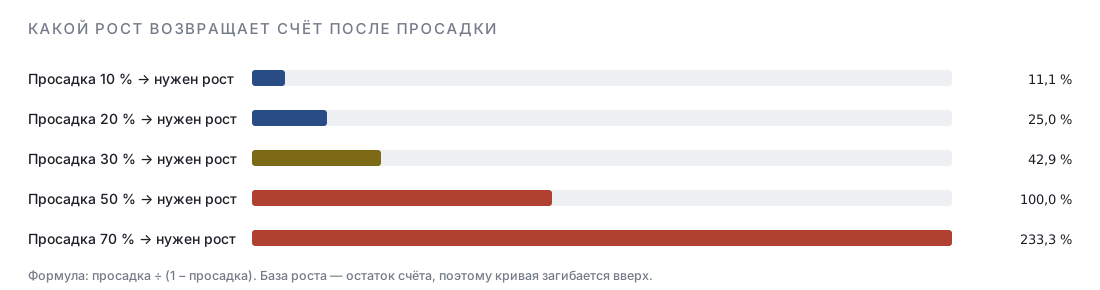
Recovering from a drawdown requires a larger percentage than the loss was: the loss and the growth that follows are counted from different bases, so the return always requires a larger percentage than the loss was. We look at the formula for the asymmetry, count the length of the return in trades and test the popular advice to «increase the volume to win it back faster».
How to come out of a drawdown: the formula for the asymmetry
the growth needed = the hole ÷ (1 − the hole)
A loss of 20 % leaves 80 % of the account, and to get back to the previous sum those 80 % have to grow by 25 %. A loss of 50 % leaves half — and requires a doubling. The deeper the hole, the faster the gap grows: up to 10 % the difference is almost invisible, after 40 % it becomes decisive.
Horizontally — the depth of the drawdown, vertically — the growth from the remainder that brings the account back to its previous level. The curve is non-linear: up to 20 % it almost coincides with the diagonal, beyond that it goes up.
How many trades and pips it takes to make a drawdown back
Percentages on their own are abstract. Let us convert them into a number of trades for a system with known parameters: 45 % winners, a target twice as far as the stop, a limit of 1 % per trade. The average result of a trade in such a system is 0.35 R, that is 0.35 % of equity.
| Drawdown | Growth needed | Trades on average | At 5 trades a week |
|---|---|---|---|
| 5 % | +5.3 % | 15 | about 3 weeks |
| 10 % | +11.1 % | 30 | about 6 weeks |
| 20 % | +25.0 % | 64 | about 3 months |
| 30 % | +42.9 % | 102 | about 5 months |
| 50 % | +100.0 % | 199 | about 10 months |
The calculation uses the compound growth formula: the number of trades = ln(1 + the growth needed) ÷ ln(1 + the average result of a trade). The values are a model and are given to compare the scale of things; the actual time depends on how the winners are distributed over time.
The main conclusion is not in the particular numbers but in their order of magnitude. A drawdown of 30 % is not «a bad month» but half a year of the account's development given back at the same quality of trading. That is exactly why the drawdown ceiling is set before, not after, it is reached.
Why «increase the volume to get out faster» does not work
The logic of the advice is clear: if every trade gives more, the return will come sooner. The arithmetic shows what actually happens.
What really speeds up the return. Nothing that depends on the size of the stake. The return is sped up only by an improvement in the expectancy of a trade — a more precise selection of entries, a further target with the same stop, a reduction in costs. Everything else changes the speed in the opposite direction as well.
A plan for coming out of a drawdown on a forex account without raising the risk
The only thing that really speeds up the return is a rise in the expectancy of a trade. Everything else changes the speed in both directions. Below is an order of actions that does not touch the size of the stake.
That is exactly what the drawdown ceiling is for: it stops the trading while decisions are still made calmly and the capital allows a return.
by the ruleTrades taken by the system and trades outside the plan. The first are ordinary work, the second an error of execution, and each is cured in its own way.
from the journalIf the trades taken by the plan give a positive expectancy, the system is fine and the matter is discipline or the size of the risk.
50-100 tradesHalf the usual risk until 20-30 trades without breaches have accumulated. The return is slower, but there is no second hole.
20-30 tradesWhat most people do and why it does not work. They increase the volume to come back faster. The arithmetic is against it: a doubled risk also doubles the next losing streak, and its base is an account that has already shrunk. That is how a drawdown of 30 % turns into 50 %, where the return already requires not 43 but 100 percent.
Frequently asked questions
How much do you have to earn to make back a drawdown of 30 %?
42.9 % of the remaining sum. The formula: 0.3 ÷ (1 − 0.3) = 0.429. At an average result of 0.35 % of equity per trade that takes about a hundred trades.
Is it worth reducing the volume during a drawdown?
When it is counted from current equity, the volume is reduced on its own — that is a built-in property of a fixed fraction. An additional cut (half the risk after the drawdown ceiling is reached, for example) is used as part of the stopping rules: it slows both the fall and the return, but it gives time to check the system.
After how long is a drawdown considered abnormal?
The reference point is a comparison with the system's own history. If the current drawdown is deeper or longer than anything seen over the test period, that is a reason to check: the conditions the system worked in may have changed.
Can an account be recovered after losing 80 %?
Arithmetically that requires growth of 400 % — that is, the account has to grow fivefold. At an average result of 0.35 % per trade that is about 460 trades, and all that time the system has to keep a positive expectancy. In practice such a return means not a recovery but building the result from scratch.
How much is that in pips on EUR/USD?
It depends on the volume. With a deposit of $5,000, a drawdown of 20 % and a volume of 0.12 lots you have to bring back $1,000, that is about 830 pips of net profit at a pip value of $1.20 for that volume. Hence the estimate of the time: trades of 40–80 pips add up to such a sum over months.
Does switching to more volatile pairs help?
No. Volatility raises the profit and the loss proportionally, while the volume for the same risk goes down. The expectancy of the system does not grow — only the speed at which it materialises changes.
Is it worth changing the strategy during a drawdown?
Only after an analysis, not in the middle of one. Changing the rules in a drawdown deprives you of statistics: it becomes unclear what exactly stopped working. It is more practical to check first whether the rules were followed, and only then change the system.
What do I do if the drawdown was caused by a series of broken rules?
Split the losses into two classes and count the result separately for the trades taken by the plan. If it is positive, what has to be restored is discipline, not the strategy: half the volume until twenty or thirty trades without breaches.
Is it realistic to come out of a drawdown in a month?
It depends on the depth and on the expectancy of the system. A drawdown of 5 % at an average result of 0.35 % per trade requires about fifteen trades — that is two or three weeks at five trades a week. A drawdown of 30 % on the same parameters takes about a hundred trades, that is, months.
Does withdrawing profit affect the speed of recovery?
It slows it down: a smaller account gives a smaller absolute profit at the same percentage. But the money withdrawn does not take part in the next drawdown, so the choice here is between the speed of growth and the protection of a result already achieved.
Read next
